
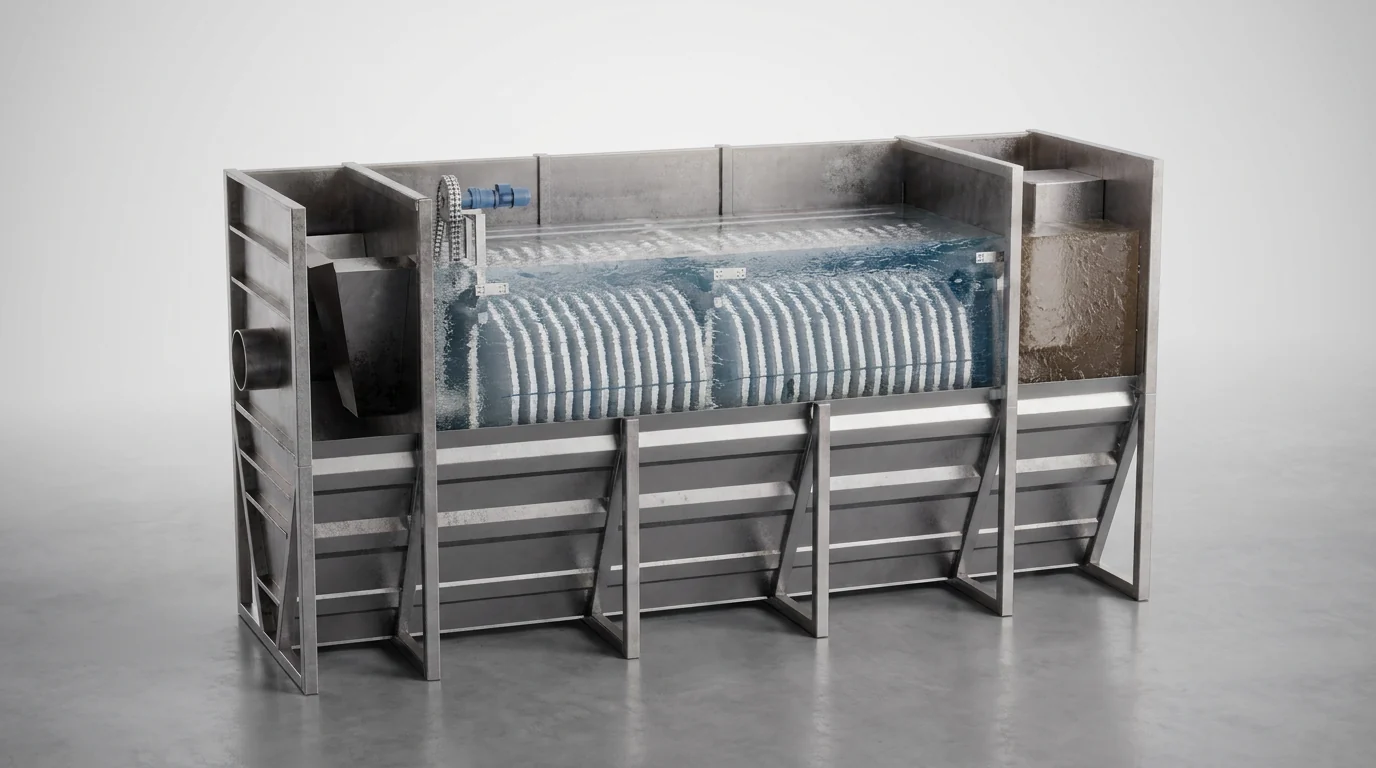
Achieving TP Below 0.1 mg/L: Advanced Phosphorus Elimination
Phosphorus discharge limits are tightening worldwide. Regulatory frameworks protecting sensitive receiving waters — lakes, reservoirs, coastal zones — increasingly demand effluent total phosphorus concentrations below 0.1 mg/L. This threshold represents a genuine engineering challenge, pushing conventional biological and chemical treatment to its limits and placing advanced filtration at the center of modern phosphorus management strategies.
Understanding how to reliably achieve these ultra-low TP targets requires a clear picture of where phosphorus exists in treated effluent, how co-precipitation chemistry works, and what role fine filtration plays in closing the gap between good and excellent performance.
Why Conventional Treatment Falls Short
Standard wastewater treatment processes — biological nutrient removal combined with chemical precipitation — can routinely achieve effluent TP in the range of 0.5 to 1.0 mg/L. Enhanced biological phosphorus removal (EBPR) pushes this lower, but process variability, sludge bulking events, and seasonal temperature shifts make consistent sub-0.1 mg/L performance unreliable without a robust polishing step.
The residual phosphorus that escapes secondary treatment exists in several forms:
- Soluble reactive phosphorus (SRP): Orthophosphate remaining after incomplete chemical or biological uptake
- Colloidal phosphorus: Submicron particles that pass through conventional settling
- Particulate phosphorus: Fine suspended solids carrying adsorbed or precipitated phosphate
Each fraction requires a different removal mechanism, which is why no single treatment step alone can reliably achieve advanced removal to sub-0.1 mg/L levels.
The Role of Co-Precipitation in Advanced TP Removal
Co-precipitation is a cornerstone of advanced phosphorus elimination. When metal salts — typically iron or aluminum-based coagulants — are dosed into the effluent stream, they react with dissolved phosphate to form insoluble metal-phosphate floc. Critically, this floc also sweeps colloidal phosphorus from suspension through charge neutralization and adsorbtion mechanisms.
Key insight: Effective co-precipitation reduces soluble and colloidal TP fractions significantly, but the resulting fine precipitate must be captured by downstream filtration to prevent it from contributing to effluent phosphorus loads.
This is the fundamental reason why co-precipitation and fine filtration are inseparable in advanced removal systems. Dosing chemistry without adequate filtration simply transfers phosphorus from dissolved to particulate form — without achieving the final removal step.
Optimizing co-precipitation for sub-0.1 mg/L targets involves:
- Precise coagulant dosing: Molar ratios of metal ion to phosphate must be carefully controlled; overdosing wastes chemicals and can generate excess sludge, while underdosing leaves soluble TP in the effluent
- Mixing intensity and contact time: Rapid mixing for coagulant dispersion followed by gentle flocculation to build filterable floc structures
- pH management: Iron and aluminum precipitation efficiency is strongly pH-dependent, with optimal ranges differing between the two chemistries
Fine Filtration as the Final Polishing Step
Once co-precipitation has converted dissolved and colloidal phosphorus into particulate form, the challenge becomes physical removal of very fine floc particles. This is where pile cloth filtration technology demonstrates its particular strength.
Pile cloth media operates through a fundamentally different mechanism than granular or membrane filtration. The three-dimensional fiber matrix of the pile layer creates a depth filtration zone where fine particles are captured progressively through the media thickness, rather than at a single surface layer. This architecture allows high hydraulic throughput while achieving fine particle removal that approaches membrane-like performance at a fraction of the energy cost.
For advanced total phosphorus removal applications, the Bioactive 5µm Microfiber pile cloth grade is specifically engineered to capture the fine metal-phosphate floc generated by co-precipitation chemistry. At 5 µm nominal filtration rating, this media reliably intercepts the submicron-to-micron particle size range where residual phosphorus concentrations are concentrated after chemical treatment.
Practical Performance Considerations
Operators targeting sub-0.1 mg/L TP should consider the following operational factors:
- Cloth conditioning period: New pile cloth media typically requires a short break-in period during which the fiber matrix becomes conditioned with process solids, after which filtration efficiency stabilizes at optimal levels
- Backwash frequency and intensity: Pile cloth systems use suction-based backwashing that cleans individual cloth panels while the rest of the system remains in service — maintaining continuous filtration without hydraulic interruptions
- Influent TSS loading to the filter: Excessive solids loading from upstream upsets can blind cloth panels prematurely; monitoring upstream clarifier performance protects filter longevity
- Chemical dosing point location: Positioning co-precipitation dosing upstream of a flocculation contact chamber before the pile cloth filter maximizes floc development and filterability
Integrated System Design for Reliable Sub-0.1 mg/L Performance
Achieving consistent advanced removal to below 0.1 mg/L TP is not a single-technology solution — it requires the integration of optimized co-precipitation chemistry with fine pile cloth filtration operating within a well-controlled process train.
Facilities that have implemented this integrated approach report stable effluent TP well within the 0.1 mg/L threshold even during variable influent loading conditions, demonstrating that the combination of precise chemical dosing and microfiber filtration creates a resilient polishing barrier.
For engineers evaluating system configurations or selecting appropriate filtration media grades for specific phosphorus targets, the Applications section provides detailed guidance on matching process conditions to the right pile cloth specification.
Key Takeaways
- Sub-0.1 mg/L TP targets require addressing all phosphorus fractions — soluble, colloidal, and particulate
- Co-precipitation is essential for converting dissolved and colloidal phosphorus into filterable form, but must be paired with fine filtration to achieve final removal
- Pile cloth filtration at 5 µm microfiber grade provides the depth filtration performance needed to capture fine metal-phosphate precipitates efficiently
- System reliability depends on integrated process design — optimized chemistry, flocculation contact time, and properly specified filtration media working together
Related: Learn more | Learn more
Read More Articles
Discover more insights on pile cloth filtration and water treatment.