
Semi-Crystalline Microplastics in Wastewater Effluents: Filtration Challenges and Solutions
Microplastic removal efficiency with advanced pile cloth filtration: up to 95% Particle size range of concern for semi-crystalline fragments: 1–500 µm Proportion of microplastics in treated effluent attributed to semi-crystalline polymers: estimated 40–60%Wastewater treatment plants are increasingly recognized as both a pathway and a potential barrier for microplastic contamination entering aquatic environments. Among the many categories of microplastics found in treated effluents, semi-crystalline microplastics present a particularly complex challenge. Their unique physical and chemical properties make them resistant to conventional treatment processes, placing greater demands on tertiary filtration technologies — including pile cloth filtration systems.
What Are Semi-Crystalline Microplastics?
Polymers can be broadly classified by their molecular structure. Fully amorphous polymers have a disordered molecular arrangement, while semi-crystalline polymers contain both ordered crystalline regions and disordered amorphous regions. Common semi-crystalline plastics include polyethylene (PE), polypropylene (PP), polyamide (PA), and polyethylene terephthalate (PET).
When these materials fragment — through mechanical wear, UV degradation, or washing cycles — they release microplastic particles into domestic and industrial wastewater streams. Because of their partially ordered molecular structure, semi-crystalline fragments tend to:
- Resist chemical degradation more effectively than amorphous plastics
- Maintain structural integrity across a wide range of temperatures and pH levels
- Exhibit variable surface energies, affecting how they interact with filter media
- Adopt irregular, angular morphologies that can bypass certain mesh-based filtration systems
These properties mean that semi-crystalline microplastics can persist through primary and secondary treatment stages and emerge in the final effluent at concentrations that remain environmentally significant.
Why Conventional Treatment Falls Short
Primary sedimentation and secondary biological treatment are designed primarily to remove suspended solids and dissolved organic matter. While these processes do capture some larger microplastic particles, smaller semi-crystalline fragments — particularly those in the 10–100 µm range — pass through with relatively little retention.
Several factors contribute to this challenge:
- Low density of some semi-crystalline polymers (e.g., PE and PP float, making sedimentation ineffective)
- Small particle size allows passage through standard secondary clarifiers
- Hydrophobic surfaces on many semi-crystalline microplastics reduce their association with biosolids flocs
- Fiber-shaped fragments from synthetic textiles (often semi-crystalline polyamide or polyester) have high aspect ratios that allow them to navigate around conventional barriers
Key insight: Tertiary filtration is widely considered the most effective single-stage intervention for microplastic removal in wastewater treatment — and filter media selection is critical to performance.
Pile Cloth Filtration as a Tertiary Barrier
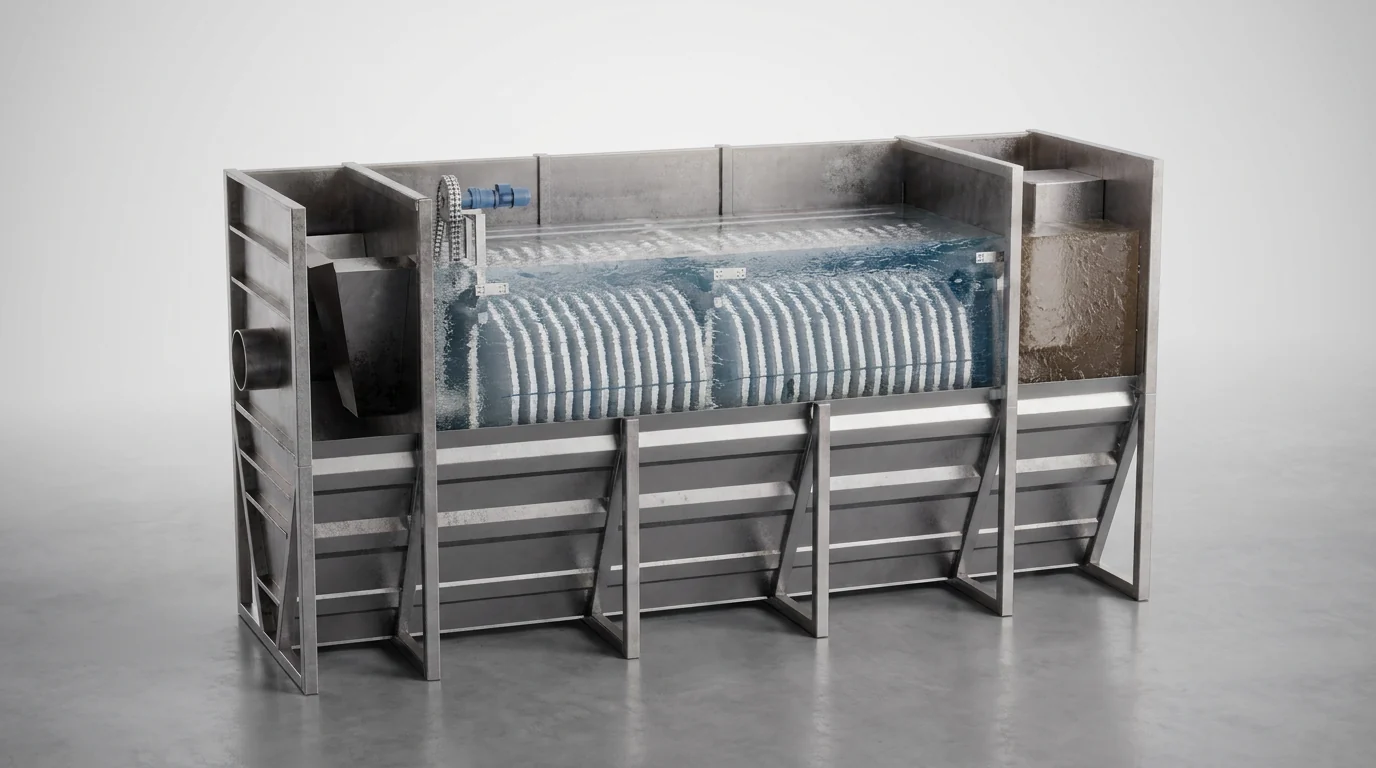
Pile cloth filtration technology has emerged as one of the most effective approaches for tertiary treatment targeting fine particulate matter, including semi-crystalline microplastics. Unlike rigid membrane systems, pile cloth filters use a three-dimensional fiber matrix that creates a depth filtration effect — particles are captured not just on the surface but throughout the pile structure.
This is particularly valuable for semi-crystalline microplastic fragments, which often have irregular geometries that might slip past two-dimensional barrier filters. The pile fiber matrix physically intercepts particles from multiple angles, improving capture rates across a wide morphological range.
Explore the full range of Applications where pile cloth filtration is deployed for microplastic and fine particulate removal.
Filtration Grade Selection for Microplastics
Choosing the right filtration grade is essential when targeting semi-crystalline microplastics in effluent streams:
- Standard 10µm Pile Filter Cloth: Effective for capturing larger microplastic fragments, including semi-crystalline PE and PP particles above 10 µm. Suitable as a primary tertiary polishing step.
- Bioactive 5µm Microfiber: Recommended when finer semi-crystalline fragments are present, such as those shed from synthetic textiles. The denser microfiber pile improves retention of particles in the 5–10 µm range.
- Supermicrofiber 2.5µm: The optimal choice for treatment plants with stringent effluent quality targets, capturing ultra-fine semi-crystalline fragments that other grades may miss.
Operational Considerations for Operators and Engineers
When designing or upgrading a tertiary filtration system to address semi-crystalline microplastics, several practical factors deserve attention:
- Backwash frequency and efficiency: Semi-crystalline fragments can embed within pile fibers due to their angular morphology. Optimizing backwash cycles prevents premature clogging and maintains consistent effluent quality.
- Hydraulic loading rates: Surges in flow — common during storm events — can temporarily reduce contact time within the pile matrix, reducing capture efficiency. Designing for peak flow conditions is essential.
- Monitoring particle size distribution: Regular analysis of influent and effluent microplastic concentrations, categorized by polymer type and morphology, helps operators fine-tune filtration grade selection.
- Combination with upstream coagulation: Pre-treating effluent with coagulation or flocculation can aggregate smaller semi-crystalline particles into larger clusters, improving pile cloth capture rates significantly.
Summary and Key Takeaways
Semi-crystalline microplastics represent a persistent and chemically resilient fraction of the microplastic burden in wastewater effluents. Their structural properties allow them to survive primary and secondary treatment, making tertiary pile cloth filtration a critical final barrier.
- Semi-crystalline polymers like PE, PP, PET, and PA are among the most prevalent microplastics in treated effluent
- Pile cloth filtration's depth-filtration mechanism is well-suited to capturing irregular semi-crystalline fragments
- Filtration grade selection — from 10µm down to 2.5µm — should be matched to the specific particle size distribution in the effluent stream
- Operational optimization, including backwash management and upstream coagulation, enhances overall microplastic removal performance
Bottom line: As regulatory pressure around microplastic discharge increases globally, investing in appropriately graded pile cloth filtration technology offers wastewater treatment operators a proven, scalable path toward cleaner effluent and reduced environmental impact.
Related: Learn more
Read More Articles
Discover more insights on pile cloth filtration and water treatment.