
Turbidity Removal in Tertiary Treatment: Targets and Technologies
Turbidity is one of the most closely watched parameters in wastewater treatment. It is a direct indicator of water clarity, suspended particle load, and — critically — the potential presence of pathogens, colloidal matter, and residual organic compounds. In tertiary treatment, achieving consistently low turbidity is not simply a regulatory checkbox; it is a fundamental requirement for water reuse, environmental discharge, and downstream disinfection efficiency.
This article explores what turbidity targets mean in practice, why they matter, and how pile cloth filtration technology addresses the challenge of reliable, cost-effective turbidity removal at the tertiary stage.
Why Turbidity Matters in Tertiary Treatment
Turbidity — measured in Nephelometric Turbidity Units (NTU) — reflects the scattering of light by suspended particles in water. High turbidity signals the presence of fine solids, biological floc, algae, and colloidal material that secondary treatment alone often cannot fully eliminate.
In tertiary treatment, turbidity matters for several interconnected reasons:
- UV disinfection efficiency drops sharply when turbidity exceeds 2–5 NTU, as particles shield pathogens from UV exposure
- Chlorination effectiveness is compromised by suspended solids that consume disinfectant and harbor microorganisms
- Water reuse standards — for irrigation, industrial cooling, or indirect potable reuse — typically demand turbidity below 2 NTU, and often below 1 NTU
- Receiving water quality in sensitive ecosystems requires low turbidity effluent to protect aquatic life and downstream ecosystems
Key takeaway: Turbidity is not just an aesthetic parameter — it directly governs the safety and effectiveness of every downstream treatment step.
Common Turbidity Targets in Tertiary Treatment
Regulatory and operational turbidity targets vary by application, but common benchmarks include:
- < 5 NTU — minimum standard for many discharge permits
- < 2 NTU — standard target for UV disinfection pre-treatment and general reuse
- < 1 NTU — required for sensitive reuse applications including food crop irrigation and some industrial processes
- < 0.5 NTU — achieved by advanced filtration systems under optimized conditions, and increasingly required for indirect potable reuse schemes
Meeting the lower end of this range consistently — across variable influent loads, seasonal changes, and biological upsets — is where filtration technology selection becomes critical.
Technologies for Tertiary Turbidity Removal
Several filtration technologies compete in the tertiary treatment space. Each carries trade-offs in footprint, energy demand, media replacement cost, and achievable effluent quality.
Sand and Multimedia Filtration
Granular media filtration has been a workhorse of tertiary treatment for decades. It performs reliably at moderate turbidity targets but struggles to consistently achieve sub-1 NTU results without chemical pre-treatment, and backwash water volumes can be significant.
Membrane Filtration (MF/UF)
Microfiltration and ultrafiltration membranes deliver excellent turbidity removal — often below 0.1 NTU — but at considerably higher capital and operating costs. Membrane fouling, chemical cleaning requirements, and energy consumption remain operational challenges, particularly at larger scale.
Pile Cloth Filtration
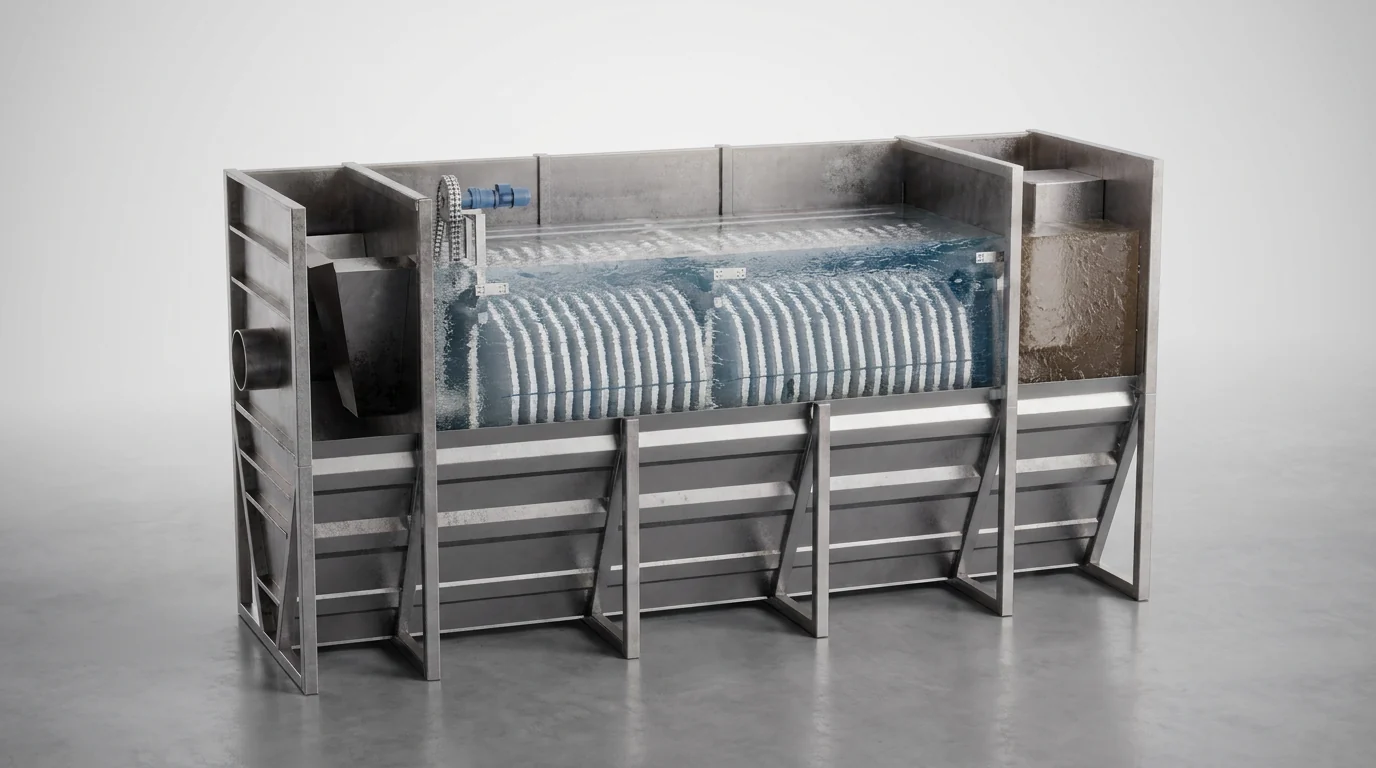
Pile cloth filtration occupies a highly competitive position in tertiary treatment: it consistently achieves turbidity results that approach or match membrane performance, at a fraction of the energy and operational complexity.
The filtration mechanism relies on a three-dimensional fiber matrix — the pile — which captures fine suspended solids through depth filtration, surface interception, and fiber entanglement. Unlike flat woven media, the pile structure provides a significantly greater active filtration surface within a compact footprint.
For demanding turbidity targets, Supermicrofiber 2.5µm pile cloth represents the leading edge of this technology. With fiber diameters engineered at the submicron scale, supermicrofiber media captures colloidal particles and fine biological floc that coarser media grades allow to pass. Effluent turbidity below 0.5 NTU is routinely achievable with this grade under properly designed operating conditions.
Practical advantages for operators include:- Continuous filtration with in-place cleaning — no process interruption during backwash
- Low head loss across the filter medium compared to granular alternatives
- Reduced chemical coagulant demand in many applications
- Long media service life with predictable replacement cycles
Matching Media Grade to Turbidity Target
Selecting the correct pile cloth grade is the single most important decision in system design. A general guidance framework:
| Turbidity Target | Recommended Media Grade |
|---|---|
| < 5 NTU | Standard 10µm Pile Filter Cloth |
| < 2 NTU | Microfiber 5µm grade |
| < 0.5 NTU | Supermicrofiber 2.5µm |
Influent characteristics — particularly secondary effluent quality, seasonal biological variation, and peak flow conditions — should always inform final media selection alongside target NTU values.
Summary and Key Takeaways
Turbidity removal in tertiary treatment is a multi-dimensional challenge that connects directly to disinfection safety, regulatory compliance, and water reuse viability. As discharge standards tighten and water reuse expands globally, the pressure to achieve sub-1 NTU effluent reliably and economically will only increase.
Pile cloth filtration — and supermicrofiber technology in particular — offers a proven, scalable pathway to meet these targets without the capital intensity or operational complexity of membrane systems. For engineers and operators designing or upgrading tertiary treatment facilities, understanding the relationship between fiber grade, filtration mechanism, and NTU target is the foundation of effective system selection.
Explore the full range of tertiary treatment applications and how advanced pile cloth media grades can be matched to your specific effluent quality requirements.
Related: Learn more | Learn more
Read More Articles
Discover more insights on pile cloth filtration and water treatment.